Investor Document Package
The whole raise package, in four weeks.
Business plan or whitepaper, pitch deck, five-year financial model, one-pager. Researched from primary sources and built around a model you can defend under questioning — not a template with your logo dropped into it.
What you get
Five documents that agree with each other.
The usual failure isn't a bad deck. It's a deck whose numbers don't match the model, and a model whose assumptions nobody wrote down. Everything here is built from one set of assumptions, so an investor can pull any thread and it holds.
| Document | What it covers |
|---|---|
| Business plan or whitepaper | Market sizing from primary sources, competitor analysis, positioning, business model, go-to-market phases, risk register. Technical whitepaper where the venture calls for one. |
| Pitch deck | 10–14 slides, investor-standard sequence, written to be read without you in the room. Delivered as editable source, not a flattened PDF. |
| Five-year financial model | Spreadsheet with live formulas and a clearly marked assumptions block. Revenue lines, cost structure, headcount plan, P&L, cash position, funding requirement. You change one input and everything downstream updates. |
| Investor one-pager | The version that gets forwarded. Designed to survive being read on a phone in ninety seconds. |
| Data room index | Structured folder of everything above plus a checklist of what you still need to produce before diligence. |
Bilingual as standard. If you are raising from investors in Singapore, the US or Europe but working in Vietnamese, you get both versions — written to the same standard, not machine-translated. We work in Vietnamese; investors read English.
Process
Four weeks, four checkpoints.
-
Week 1 — Discovery and assumptions
A written brief, one 45-minute call, and access to whatever you already have. I come back with the assumptions block: every number the model will rest on, with its source. You approve it before anything is built on top.
-
Week 2 — Research and model
Market sizing, competitor analysis, and the financial model built and stress-tested. You see the model before the narrative, because the narrative has to follow the numbers rather than the other way round.
-
Week 3 — Narrative documents
Business plan or whitepaper drafted, pitch deck built, one-pager written. First full draft delivered for comment.
-
Week 4 — Revision and handover
Two rounds of revisions, second language version, data room assembled, source files handed over. A recorded walkthrough of the model so you can answer questions about it yourself.
Case study
RWA Tokenization Platform
A full fundraising documentation set for a platform tokenizing real estate and operating businesses for international investors — built end to end, in both English and Vietnamese.
The brief
A venture entering a market growing fast enough to attract capital, and regulated heavily enough that a vague plan would end the conversation. The documentation had to survive scrutiny from investors who already knew the sector.
The problem
Tokenized real-world assets sit between securities law, blockchain engineering and asset management. A generalist writer can produce the narrative but not the licensing path or the token architecture. Those are exactly what a serious investor asks about first.
The result
A complete package: strategy document, bilingual whitepaper, bilingual pitch deck, five-year model, licensing plan, two technical plans, an interactive investor dashboard demo, and three fully costed build scenarios.
What was actually produced
- Strategy & architecture document — market sizing, competitor analysis across six incumbent platforms, positioning, business model, legal framework and technical architecture in one place.
- Whitepaper, English and Vietnamese — full technical and commercial document, written to the same standard in both languages.
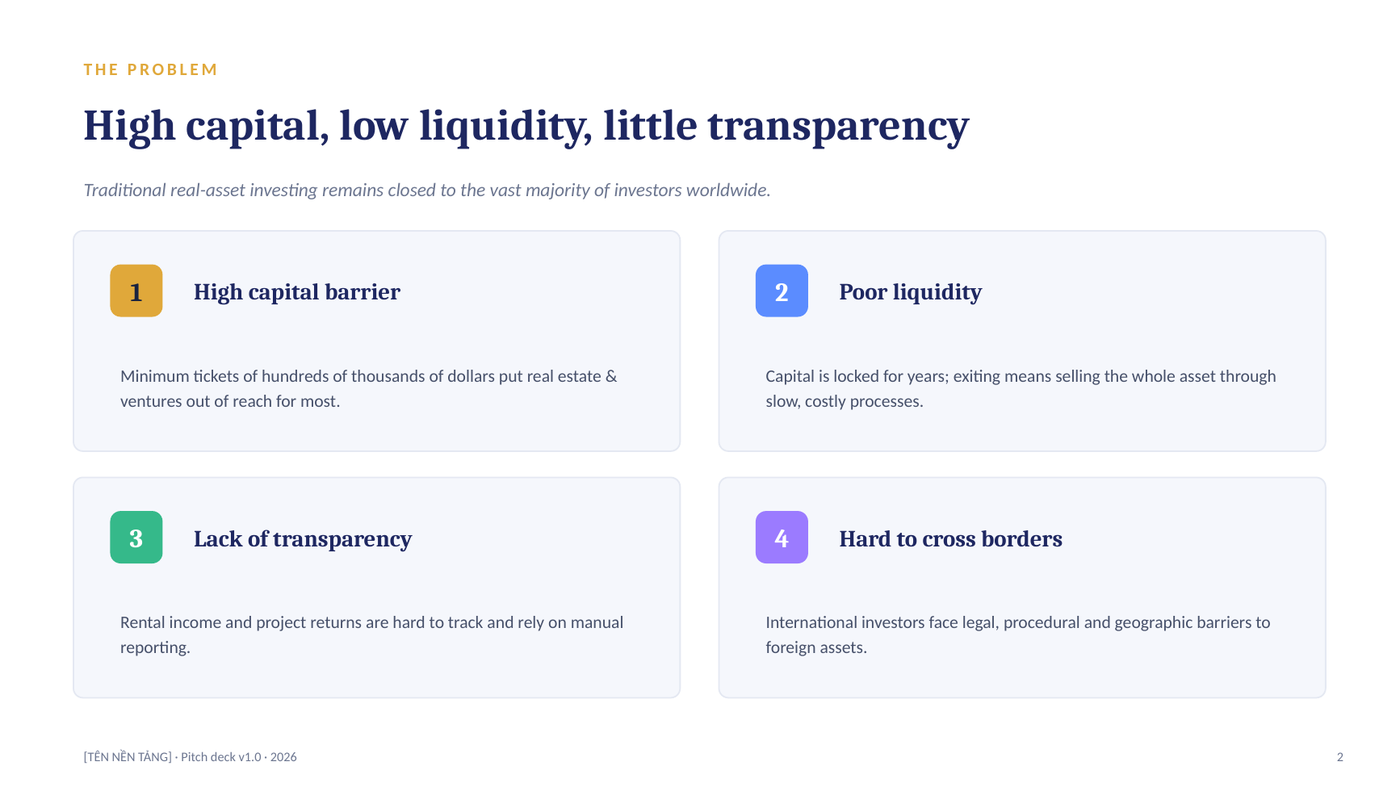
- Pitch deck, English and Vietnamese — delivered as editable source.
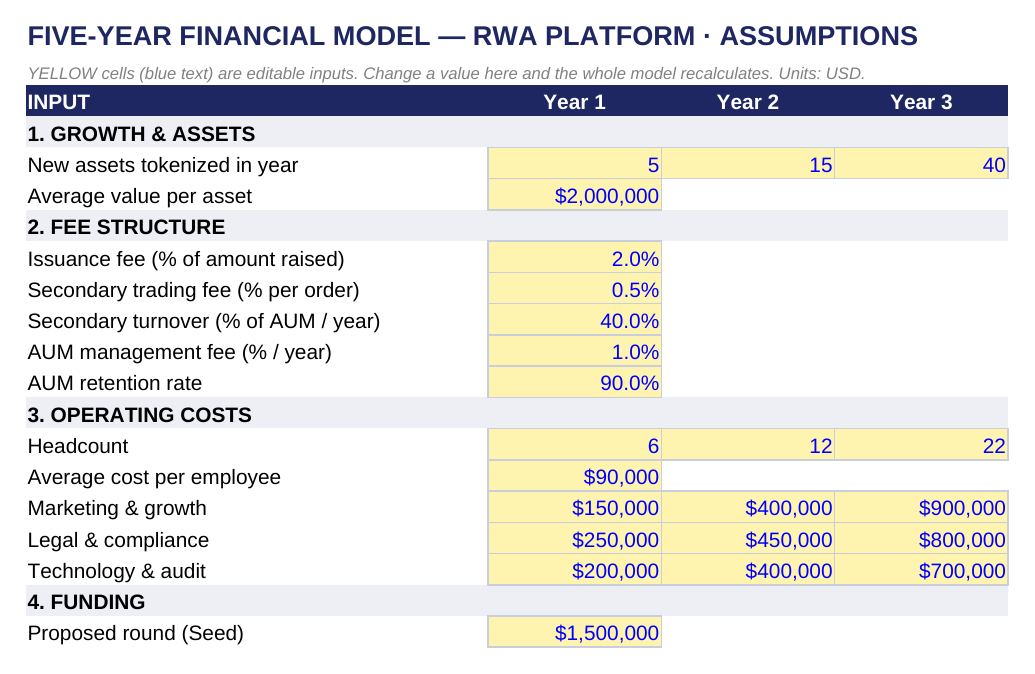
- Five-year financial model — spreadsheet with a live assumptions block: asset count, average asset value, three fee lines, retention, headcount, marketing, legal and audit cost. Drives AUM build, revenue by line, P&L and funding requirement.
- Licensing and legal plan — seven jurisdictions compared, a dual-hub structure recommended, and a four-phase path from sandbox to full operation.
- Core technical plan — token standard selection, module architecture, and a four-week milestone plan for the contract layer.
- Off-chain technical plan — backend, identity verification and frontend, sequenced against an eleven-month delivery timeline.
- Three costed build scenarios — full build, software and audit only, and a lean scenario with a small distributed team, each with its own budget and Gantt.
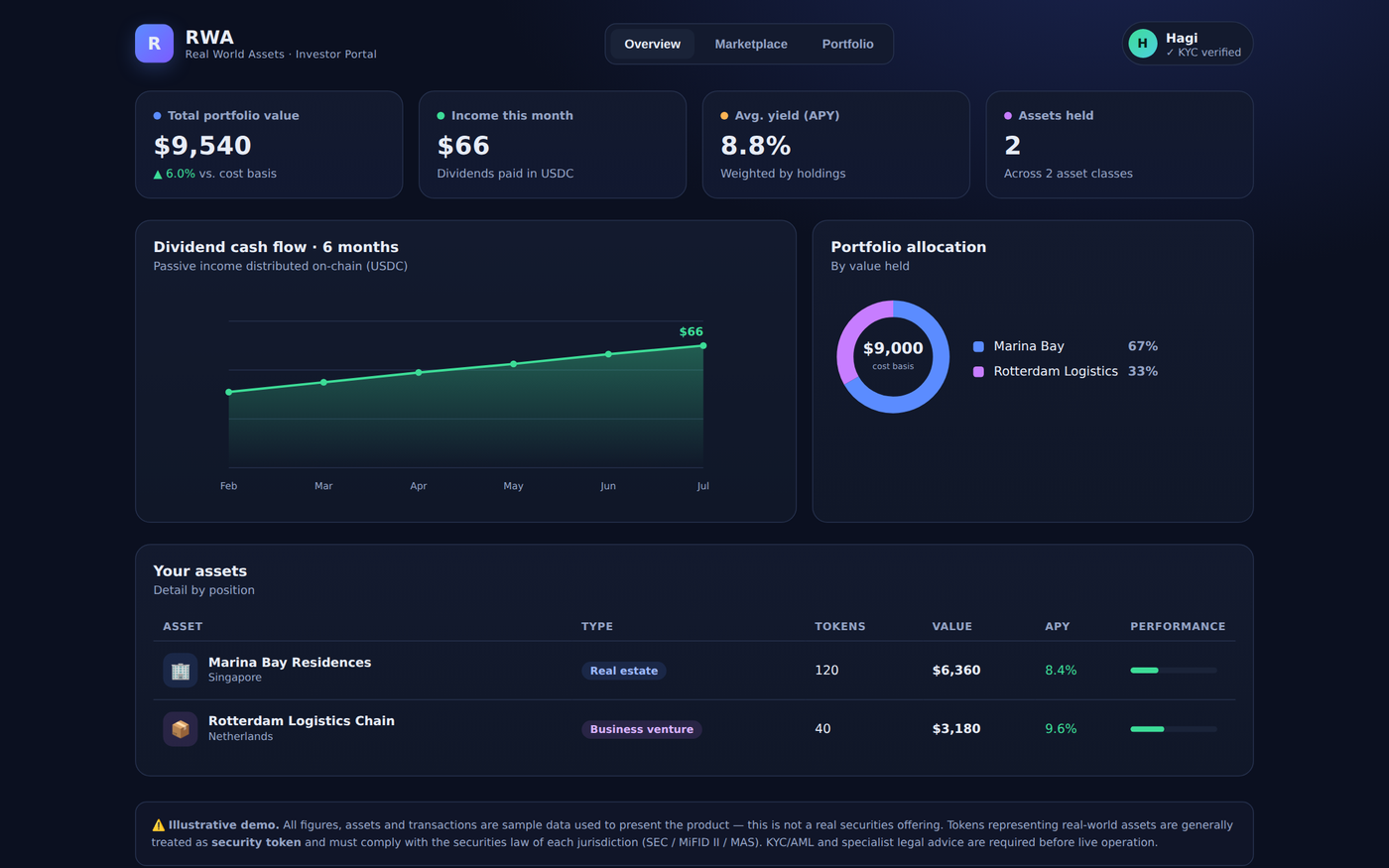
- Interactive investor dashboard demo — a working page, not a screenshot, so the product could be shown rather than described.
The parts that mattered
A defensible position rather than a bigger claim. The competitor analysis showed the large incumbents split into two groups: infrastructure vendors selling tooling to other people, and single-asset-class platforms. The recommendation was to avoid competing head-on with the treasury-bond platforms and take the fragmented real estate and operating business segment instead. That distinction is what makes a market slide credible.
A model built on visible assumptions. Every input sits in one marked block — new assets per year, average asset value, issuance fee, secondary trading fee, annual management fee, retention rate, headcount and cost lines. Revenue comes from three independent lines rather than one hopeful number, and an investor can change any assumption and watch the funding requirement move. The model ships with an explicit note that the figures are illustrative until validated — because a model that pretends to certainty is the fastest way to lose a room.
The legal work done before it was asked for. For anything touching securities, the first serious question is which regulator and under what licence. Seven jurisdictions were compared on cost, timeline and feasibility, and the recommended structure came with a phased path rather than a single leap. That section is usually missing from fundraising documents, and its absence is usually where the conversation stops.
Note on scope. The legal plan is strategic direction, not legal advice, and says so in the document. Financial figures are an illustrative model pending validation. Being explicit about both is a feature — investors trust a document that marks its own edges more than one that doesn't.
Fit
Who this is for.
- Founders raising pre-seed to Series A who have the business but not the documentation.
- Southeast Asian ventures raising abroad who need investor-standard English documents without losing precision in translation.
- Technical founders who can build the product but not the commercial narrative and the model behind it.
- Fintech, tokenization and asset-backed ventures where the regulatory path is part of the pitch, not an afterthought.
Who it isn't for.
If you need a five-page business plan for a bank loan, this is the wrong size of engagement and I'll say so. If you want a document that makes numbers look better than they are, I'm not the right person — the whole value here is that the model survives questioning.
Free resource
The 12 questions international investors ask.
A checklist for Vietnamese and Southeast Asian founders raising abroad — the questions that most local fundraising documents don't answer, and what a sufficient answer looks like. No email required.
Start here
Tell me what you're raising for.
A short note about the venture, the stage, and who you're raising from. If it's a fit I'll come back with scope, price and a delivery date within two working days.